***
Far From Disney
ALL PHOTOS BY JAPAN ON FOOT 2001/2002
FROM ISHIGAKI Island, we hopped on a crowded speedboat that leaped across an angry sea as we headed into the eye of a storm. My whole body stiffened with fright and I broke out in a cold sweat as I frantically looked around for life jackets, only to discover there were none. Etsuko’s senses were dulled after taking the motion-sickness tablets. She was in a zombie-like, bleary-eyed state of half-sleep while I, in a state of terror, clutched onto the seat in front of me. My arms trembled as I peered out at the two-metre-high waves that tore at the Anei. I feared that at any moment we would capsize. I hadn’t been gripped by such fear since a river-rafting expedition several years earlier. During the day’s venture on the Zambezi River, renowned as the roughest river in the world, the raft had capsized three times on the volatile rapids. With each dipping, I became more resigned to the fact that I would probably not live to see the end of the day. The rapids had sucked me down time and time again, churning me in their bowels of water as if I were some rag flung in a washing machine. It had been an agonizing experience to realize that it was impossible to swim, and that the more I tried to, the more I was sucked down into the hungry mouths of the rapids and left spluttering on mouthfuls of water and gasping for air the moment I was tossed back to the waters’ surface. My whole life had flickered before my eyes. I was completely helpless; I couldn’t even save myself, let alone try and help Etsuko who, at that time, couldn’t swim a stroke. Two tourists had died on the river just a month earlier; an elderly man had a heart attack when his raft capsized on a rapid and, on another Zambezi expedition, a young English woman had drowned. Apparently, her shoelace had got caught around the branches of a huge tree on the river’s bottom. Parts of her body were found a few days later, much further downstream.
"The crocodiles had eaten most of her," our African guide had told us before Etsuko and I had joined up with a group of fellow backpackers and signed up for the river adventure. But, after the near-drowning experience on the Zambezi, I swore I would never participate in any water sport again. Etsuko, however, surprised me by saying that she would love to do it all over again. I was deeply impressed by the fact that she had not let her near-death experience dampen her enthusiasm for rafting.
"I just kept wondering when I would ever come up above water, that it was taking such a long time to float up to the surface and that I couldn’t see the raft or anybody else. I felt quite calm and curious about the predicament; that I was going to die because I reached a point where I could no longer breathe, and then, finally, I was spluttering with my head above water," she calmly told me after the incident.
I had gone into spasms on hearing that Etsuko had not kicked one foot or pushed herself upwards with her arms in order to reach the river’s surface sooner. It was something that I presumed would be a natural human reflex reaction when drowning. On return to Japan, Etsuko succumbed to my nagging and took swimming lessons. She turned out to be a much stronger swimmer than I am, but as I peered out of the window of the Anei, I knew that there would be no hope for any of us if the vessel capsized out in this raging sea. The small vessel was hurled higher and higher on the tails of waves and would then come crashing down with an almighty thump that threw passengers and crew from their seats. Etsuko had resigned herself to fate.
"There’s nothing that can be done," she sleepily slurred.
She was right, of course. I only wished that I could be more accepting of death and face it with such calmness. Instead, I found myself becoming irritated by a group of young men who whooped and cheered every time our vessel was thrown into the air or made a precarious crash-landing. Couldn’t they appreciate the potential danger? Why were they behaving like we were on some roller coaster at Disney? The crew was tense; fear was written plainly across the three men’s faces. Perhaps they regretted not canceling the voyage, I mused. The ticket sellers had told us that probably all sea crossings would be cancelled.
"The weather’s not looking so good. A typhoon is on the way. I doubt anyone will be leaving today for Hateruma," a middle-aged woman had warned us just a few hours before.
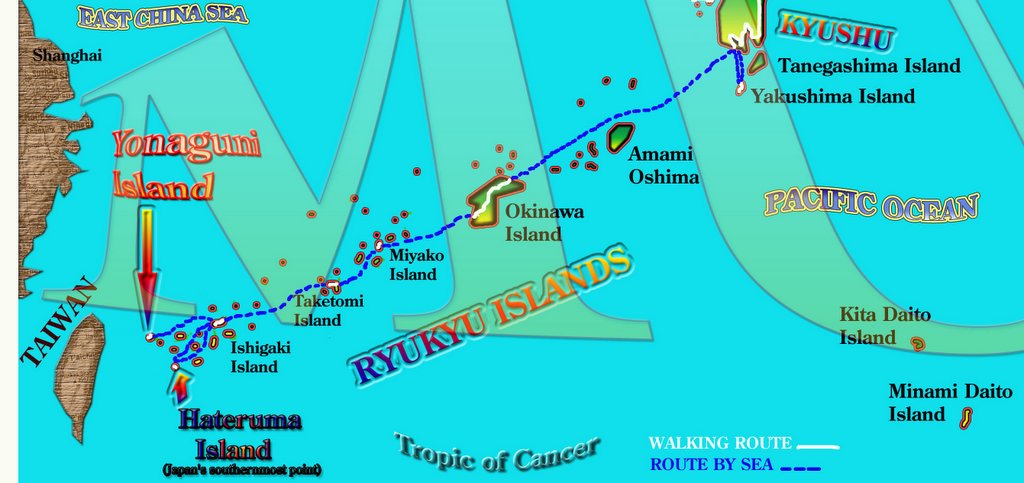
Then, at the last minute, we were told tickets were being sold; the boat would leave for Hateruma after all. Passengers and crew eventually staggered off the Anei, out onto dry land. As soon as my feet touched the asphalt, I threw up. The thought of another sea voyage the following day made me shudder. We had quite a few more sea voyages yet to make before reaching Yonaguni-jima island. The same stretch of water would take us back to Ishigaki Island, from where another vessel would spirit us to nearby Taketomi Island. And, from Taketomi Island we would need to return yet again to Ishigaki Island in order to board the ship that would take us even further out to sea, to our ultimate destination.
"We can always fly, if you want," Etsuko offered, seeing that I was badly shaken, but I didn’t want to succumb so easily to my fears. After all, we had initially agreed that Japan on Foot was a walk.
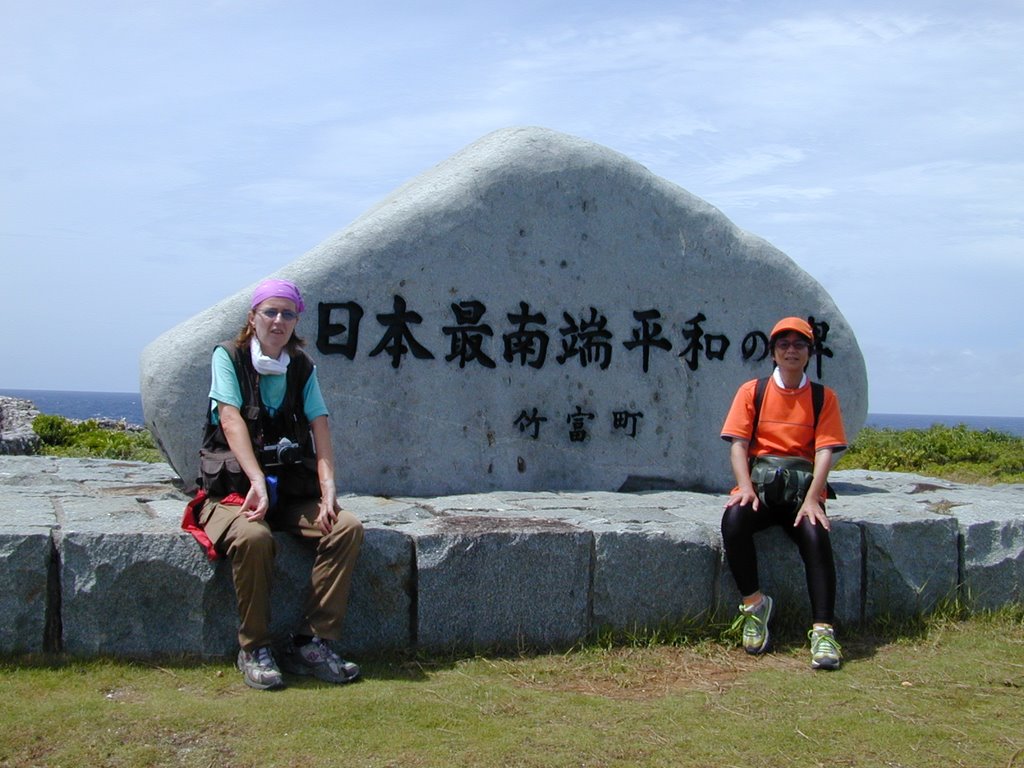
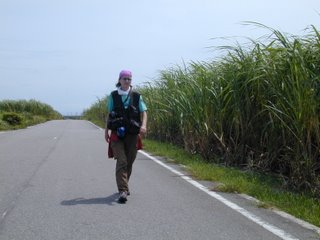
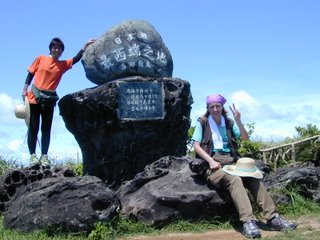
"To fly would spoil the spirit of our walk. I just can’t wimp out like that, not now; we’re so near to reaching Yonaguni," I said. We trotted on past fields of towering sugar cane, palms and banana trees where goats snuffled around for food. Finally, we found what we had come looking for: the rock boulder that marks Japan's southernmost inhabited point.
Paradise Lost
ALL PHOTOS BY JAPAN ON FOOT 2001/2002
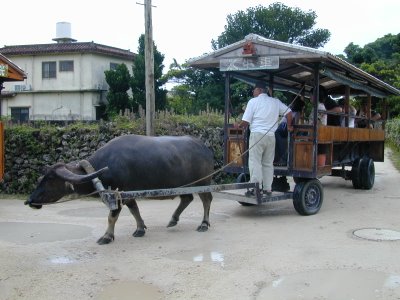
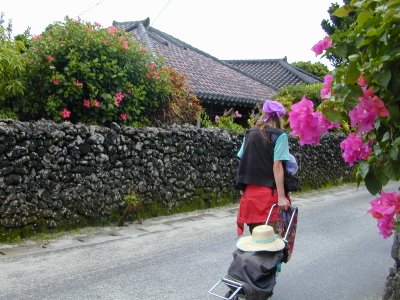
AFTER A ten-minute boat trip from Ishigaki Island, Etsuko and I alighted on yet another Okinawan Shangri-la—Taketomi Island. We spent two nights on this isle of about 270 souls. With a circumference of less than ten kilometes, it takes less than three hours to stroll round it, but Etsuko and I decided not to circumnavigate the island. Instead, we were happy just to meander along its country lanes, admiring the shisa (lions-dogs) that adorn the gateposts and beautiful red-tiled roofs of the houses here. The shisa has long been believed to ward off evil spirits, but I really couldn’t imagine that anything more malevolent than poisonous snakes could haunt this island. Occasionally, a bull, pulling a cartload of tourists, would mosey on past us, giving a weary snort or throwing us an indifferent, bleary-eyed glance. Coral walls protect Taketomi Island’s homes from lashing typhoon winds, and gardens flow over with an abundance of tropical flora and fauna—bougainvillea and hibiscus flowers burst forth here and there, while banana trees, sugar cane and palms sway in the gentle sea breeze. Huge butterflies in kimono of blacks, deep reds and purple flitted constantly passed us.
Taketomi was truly idyllic, and we were only sad that our sojourn on this little paradise would be so short.

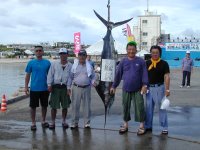
The walk had really come to an emotional ending for us once we arrived in Shuri City, on the Okinawa mainland. But now, as we realized that the next sea voyage would spirit us to Yonaguni Island, our destination goal, Etsuko and I were plagued by an incredible downer. We never doubted that we could cover such a great distance on foot, but the isle on which Etsuko’s mother and grandmother were born and raised, had for more than a year felt like a lifetime away. In some kind of way, neither of us ever wanted to reach the shores of Yonaguni Island and explore the underwater structure that lies off its shores that some claim to be the ruins of Mu—the Asian equivalent of Atlantis. From Ishigaki Island we sailed to our destination goal. It felt quite unreal when we finally stepped down the gang plank and onto the shores of Yonaguni Island. As soon as we did though we were drawn into festivities that were taking place, leaving little time for me to brood. Fishermen were sailing small boats into the port to unload their catches of billfish for the annual Billfishing Contest. Cranes were lifting up the carcasses of fish that weighed close to two-hundred kilograms. I had never seen a spectacle quite like it since my early days in Tokyo when I had made a trip down to Tsukiji Fish Market, reputed to be the world’s biggest fish market. Much laughter and cheering was going on as islanders took to a set-up stage to sing Okinawan folk songs and announce the weight of the latest big catch.
 Etsuko and I grabbed a couple of beers and some fried squid at one of the nearby marquees and sat ourselves down to absorb the goings-on of the day, before signing up for a trip in a glass-bottomed boat that would take tourists out to view the Iseki Point, the underwater structure that had been found some years earlier by one of the island’s divers. Just a few weeks before, we had met with Dr. Masaaki Kimura , a geologist and a professor at the University of the Ryukyus, who maintains that the structure is partially man-made and that beyond this, it is a testament of a lost civilization, one that predates that of Egypt and all other known civilizations.
The End of the Road
ALL PHOTOS BY JAPAN ON FOOT 2001/2002
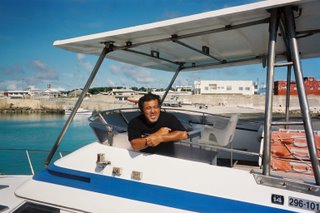
IT WAS in 1986 that Kihachiro Aratake went diving off the shores of Yonaguni Island. He hoped to find a new spot to show tourist-divers hammerhead sharks. The native islander, however, discovered something far more exciting—a huge underwater structure that he could only imagine was an ancient ruin. Some of the island’s fishermen had talked of a structure that they occasionally caught a glimpse of when just one hundred metres off shore, but Mr. Aratake found himself exploring at close range something he couldn’t imagine to be true, and so he decided to keep it a secret.
“I was certain it was an ancient ruin. In all my years of diving, I had never seen anything quite like it. However, since it became known to the academic world many specialists, from Japan and overseas, have dived down to study it. Some believe it is partially man-made, others claim it is purely natural, but either way it is an incredible structure,” the fifty-five-year-old diver excitedly told us at his home on Yonaguni Island, while pulling out photographs and slides of the Yonaguni Submarine Pyramid for us to view. Etsuko and I had already viewed the structure from a glass-bottomed boat and were aware of how impressive it is, but Mr. Aratake’s photography had truly captured the magical essence of this mysterious underwater world that lies twenty-five metres under the ocean. Like all the other diving points on the island, Mr. Aratake named this one too. “I called it Iseki (Ruins) Point because it resembles the ruins of an old temple with a pyramidal structure. And, now the main diving attraction on Yonaguni is not hammerhead sharks; it’s Iseki Point, and my discovery of it has ended up making me quite famous,” laughed Mr. Aratake, who over the years has dived down with such people as the famed French diver Jacque Mayol, the radical U.S. geologist Robert Schoch, as well as Britain’s Graham Hancock, who has written several books on his investigations to prove that a lost civilization, one much older than Egypt’s, once existed. But could it be possible that Iseki Point is man-made? Is it possible that it could date back ten thousand years and attest to the existence of a yet unknown civilization, one that predates ancient Egypt? Some people argue that what lies under the ocean at Yonaguni Island is the remains of Mu, a lost civilization of mythical proportions, one that is Asia’s equivalent of Atlantis. However, one Japanese academic is adamant that Iseki Point is man-made. A geologist with more than thirty years experience, and a professor at the University of the Ryukyus on the main Okinawan island, Dr. Masaaki Kimura maintains that Iseki Point is man-made, probably ten thousand years old and serves as evidence of a civilization that he light-heartedly calls Ma.
“I don’t believe that Mu existed. I don’t believe that such a huge continent ever existed in the South Pacific, but I do believe that a huge continent existed in the West Pacific Ocean and that Okinawa was once part of that continent. I call this lost continent the West Pacific Paleo Lands, or Ma Land for short,” Dr. Kimura told Etsuko and me when we interviewed him prior to sailing out to the smaller Okinawan islands.
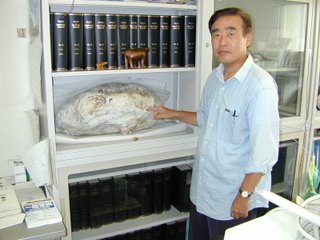
“Chinese mythology refers to an ancient civilization in the east called Horai, meaning paradise, or utopia. There is an ancient bell in a museum in Shuri City that has the word Horai engraved on it; you can also find similar bells, marked the same way, in Taiwan. Several ancient Chinese documents refer to Horai and its having been submerged under water. In Okinawa, you find the legend of Nirai Kanai, people who are coming from the bottom of the sea, and in Japan, the legend of Urashima Taro is well known but is a legend that can also be heard in India and Tibet,” continued Dr. Kimura, who has dived out to Iseki Point more than one hundred times since 1992. During these dives he takes rock and coral algae samples for geological testing, takes photographs and measures features that he maintains prove that the structure is man-made. He has also found tools on the seabed and rocks bearing carved symbols, as well as rock reliefs of various animals--from bird and turtles, to what appears to be a boar or cow. Dr. Kimura showed us slides and photographs of what he maintains are roads associated with drainage canals, as well as tool marks in the rock structure, flat terraces, straight walls, pyramidal steps and various other characteristics that he maintains prove that the structure is, beyond a shadow of a doubt, not simply a natural phenomenon.
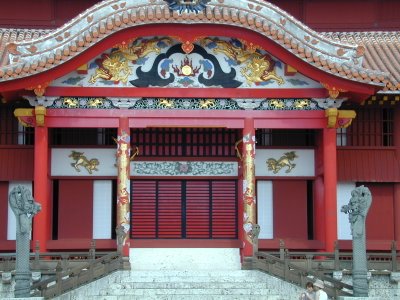
Stone tools and what Dr. Kimura says is a Moai-like rock-carving are among other items that tend to back up his theory. “Iseki Point seems to have been fabricated on land and then submerged underwater. Our surveys reveal that the overall shape and features of Iseki Point are greatly similar to gusuku (castles) in ancient Okinawa, and particularly show resemblance to Shuri and Nakagusuku castles (on Okinawa island), explained Dr. Kimura. “The gusuku has been thought to be something like a combination of a castle and a temple, and the remains of gusuku look like a sort of pyramid. The cliff steps at Iseki Point resemble a stepped pyramid, and dating tests I have conducted suggests that this structure is around ten thousand years old,” Dr. Kimura told us. The professor showed us slides of what he believes are rock carvings of a bird and turtles, as well as of the “Moai,” the canals, tool marks and the steps of what he has dubbed the Yonaguni Submarine Pyramid. Certainly, to the layman he presents striking evidence that what lies under water must indeed be manmade. But, although some geologists and archaeologists support his view, most insist that the structure is nothing more than a natural freak. Dr. Kimura is saddened by the thought that it is more likely that Western academics will be the first to seriously study the structure and verify his theory, rather than Japanese. “Japanese archaeologists are very conservative; they don’t like to work with things that they are not familiar with and especially if it involves work that could prove to be threatening to the status quo and shake-up agreed on archeological theories and history,” he said. Etsuko and I took a morning’s crash-course in diving, but unfortunately we didn’t have what it takes to make the plunge out to Iseki Point that same day with a group of skilled divers that had signed up with Mr. Aratake’s diving school. “Don’t worry, we have the clearest waters in the world here,” Mr. Aratake comforted us. “Just put these goggles on and hang off the edge of the boat while I pull you across Iseki Point,” he laughed. Huge waves lapped over us and we gagged on mouthfuls of water, but below us lay a marvelous, mythical world; one whose true mystery waits to be wholly unraveled. It was the most unforgettable experience, the topping on the cake of our long walk.
***
On August 15th, 2002, the Japan on Foot project officially ended on Yonaguni Island, Okinawa, with our snorkel out over Iseki Point, what some claim is the remains of the lost civilization of Mu. The project, which started May 9th, 2001, from Cape Soya, Hokkaido, involved Mary King and Shimabukuro Etsuko walking an actual distance of 7,494 kilometres.

READ PART 6: THE FIRST LEG OF OKINAWA
READ KYUSHU